
Another Birthday
Thinking about Dante's Commedia, life guides and recycled souls

12,784. The number of days I have been alive on planet Earth, and some. Google calculated that for me. I wanted to be accurate about leap years.
I have reached my Dante year. Thirty-five. In the Commedia (aka The Divine Comedy), Dante places himself at the gates of hell during his thirty-fifth year, the halfway point of life, according to the biblical lifespan of seventy years. Considering the biblical lifespan, I have roughly 12,784 days remaining, if I make it to seventy. If you knew when you were going to die, what would that change? Would it make a difference to how you live, the decisions you make, the people you choose to spend time with?
Nel mezzo del cammin di nostra vita
mi ritrovai per una selva oscura,
che la diritta via era smarrita.
Using the Robert and Jean Hollander translation, which was a favourite of my professor: Midway in the journey of our life / I came to myself in a dark wood / for the straight way was lost.
Although a theological work, Dante’s ‘dark wood’ is more of a mid-life crisis than a crisis of faith. He wrote the Commedia after being exiled from his beloved Florence for picking the wrong political side. The poem is his understanding of faith, morality and salvation, but it’s also a bit like a high-brow bitchy gossip column. I have no faith, am suspicious of moral ideas, and I do not believe in the religious concept of salvation. But I do love gossip. And there is tons of it. Transforming himself into a pilgrim character, we follow thirty-five year old Dante on a three-day odyssey to salvation over the Easter weekend of 1300 CE.
The Commedia is a poem, divided into three cantiche (books), with one introduction and thirty-three cantos (episodes) in each book, to make a total of one-hundred cantos. It’s written in terza rima, which are three-line stanzas (tercets). Organised religion loves numbers. Three is a magic number. A vertical reading of the Commedia carries you chronologically through Dante’s journey through Hell (punishment), up to Purgatory (purification), and finally ascending into Heaven (enlightenment). Dante has three Guides along the way, all historical figures with an allegorical function: Virgil (reason), Beatrice (divine grace and revelation), and Saint Bernard of Clairvaux (contemplation and devotion).
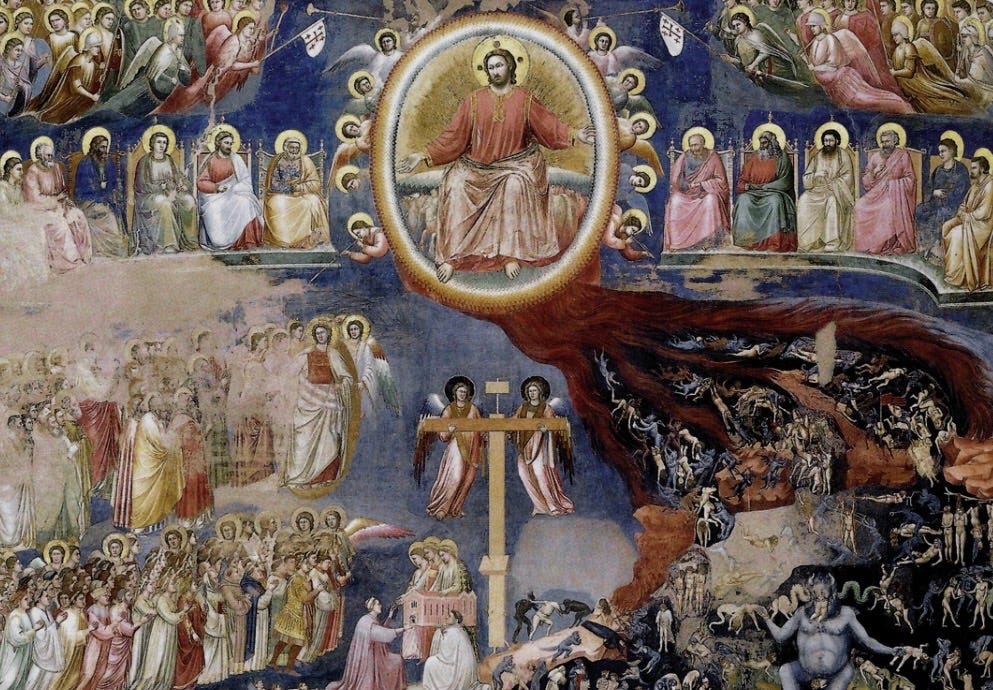
The poem almost exclusively features historical and living figures from Dante’s Italy (gossip!), whom he either condemns or saves based on his own moral code - famously placing the Pope at the time, Boniface VIII, in the Eighth Circle of Hell for simony (he is eternally dunked upside down into holes while his feet are scorched by flames!). Dante wrote the Commedia in the vernacular (Old Tuscan for him), a radical move away from the traditional Latin, aimed at a wider readership (it worked, and this is why Tuscan became the official Italian language in the newly unified State in the nineteenth century).
What fascinated me about the Commedia was the harsh medieval Christian morality, the imaginative torture methods, and the ‘horizontal’ reading. Each numbered canto across the three cantiche is thematically related, but almost every canto, non-related by number, also has a second thematic match across the cantiche. Intricately woven. Many, many layers. The scope of the work is insane. It lends itself well to seven-hundred years of commentary and analysis.
I am reflecting on my Guides: the people I have encountered throughout life thus far who have shown me a different way to be in or see the world. My Guides have always been unplanned encounters, appearing just at the right moment in time. None of them know that I consider them Guides. Their presence can be fleeting or lifelong. And the new portal they open in my mind is the product of conversation and observation. I have not yet assigned any of them an allegorical function. However, every one of my Guides has an insatiable passion for life and curiosity about the world around them. Almost all of them live somewhat unconventional lives compared to the masses, although there is a finance bro in the collection, one of the most laidback people I have ever known (I often ask myself: what would B. do in this situation? And I feel relaxed by whatever realistic imagined response I come up with).
12,784 days. I remember every Guide, and the time period that they appeared. But there is so much I don’t know about my own life. For how much of my time was I asleep? Imagine being able to watch a montage of every dream you’ve ever had. How much time have I spent in the company of friends? At work? By the sea? Reading? Watching films? Genuinely laughing? Feeling in love? Crying? Feeling anxious? Feeling as if I was in the right place, at the right time, with the right people?
When Dante meets Virgil, they bond instantly and understand each other immediately. Despite belonging to two different worlds centuries apart, they seem to know each other. As I thought about Guides, I also thought about the people I have met who I have felt I have known my whole life in an instant. The immediate bond is mutual. A strange and exciting feeling.
The head winemaker at the biodynamic winery I have worked two harvests at is very spiritual in a kind of pick’n’mix pagan-Buddhist way. He believes in the recycling of souls. He believes that he and his current partner met in a past life and have reconnected in this one. He believes that, for better or worse, their souls are intrinsically bound together. But, outside of romantic love, the idea of souls encountering each other over millennia, finding each other again and again, in new worlds and different times, without memories of previous encounters but with a memory of the soul contained within the eyes and the movements and the mind, is a beautiful concept.
Many of my close friends made later in life could fall into the recycled soul category. I have gotten good at recognising them. How many more will I have the opportunity to meet? Where are they now and where will they be when we meet? What adventures will we have together? It’s a nice thought.