
A Pilgrimage
Leon Battista Alberti and the passage of time

Mantova, a city on the border of Lombardia and Emilia Romagna, has been on my radar for a decade. The architect Leon Battista Alberti designed two churches here: Chiesa di San Sebastiano and Basilica Sant’Andrea.
Alberti, a polymath of the Early Renaissance, packed a lot into his sixty-eight years. He studied law in Bologna, became a priest in the Vatican, and then entered the service of various courts across Northern Italy as a writer, philosopher, mathematician, and architect with seemingly uninhibited access to patron funding. Over a decade, Alberti wrote De Re Aedificatoria, the first ever printed book on architecture (1485). Alberti’s text is modelled on the Ten Books on Architecture written by Vitruvius for the Emperor Augustus between 20-30 BCE. Vitruvius’s manuscript was re-discovered during Alberti’s lifetime in a Swiss monastery - originally founded by an Irish monk no less (St. Gall). These texts, these architectural treatises, set out to codify the purpose, structural qualities and decorative motifs of architecture. Concepts long lost today.
Alberti’s designs are monumental. They are made from studies, as a study, to be studied. They are an amalgamation of his observations of the ruins of the Roman forum (partially excavated in the 14th Century - we have Mussolini to thank for the extent of the present-day forum, grazie Benito). In Mantova, Alberti superimposed the form of a classic tripartite triumphal arch across the facade of Sant’Andrea and replicated this motif repeatedly throughout the interior. The cavernous interior of the basilica is roofed by a singular barrel vaulted nave, with three towering barrel vaulted chapels lining both lateral walls. A nod to the forum’s Basilica of Maxentius. Alberti loved the barrel vault. He was, in fact, the first person to employ the barrel vault since the Fall of Rome. Basilica Sant’Andrea can be read as Alberti’s final ode to ancient Roman architecture.
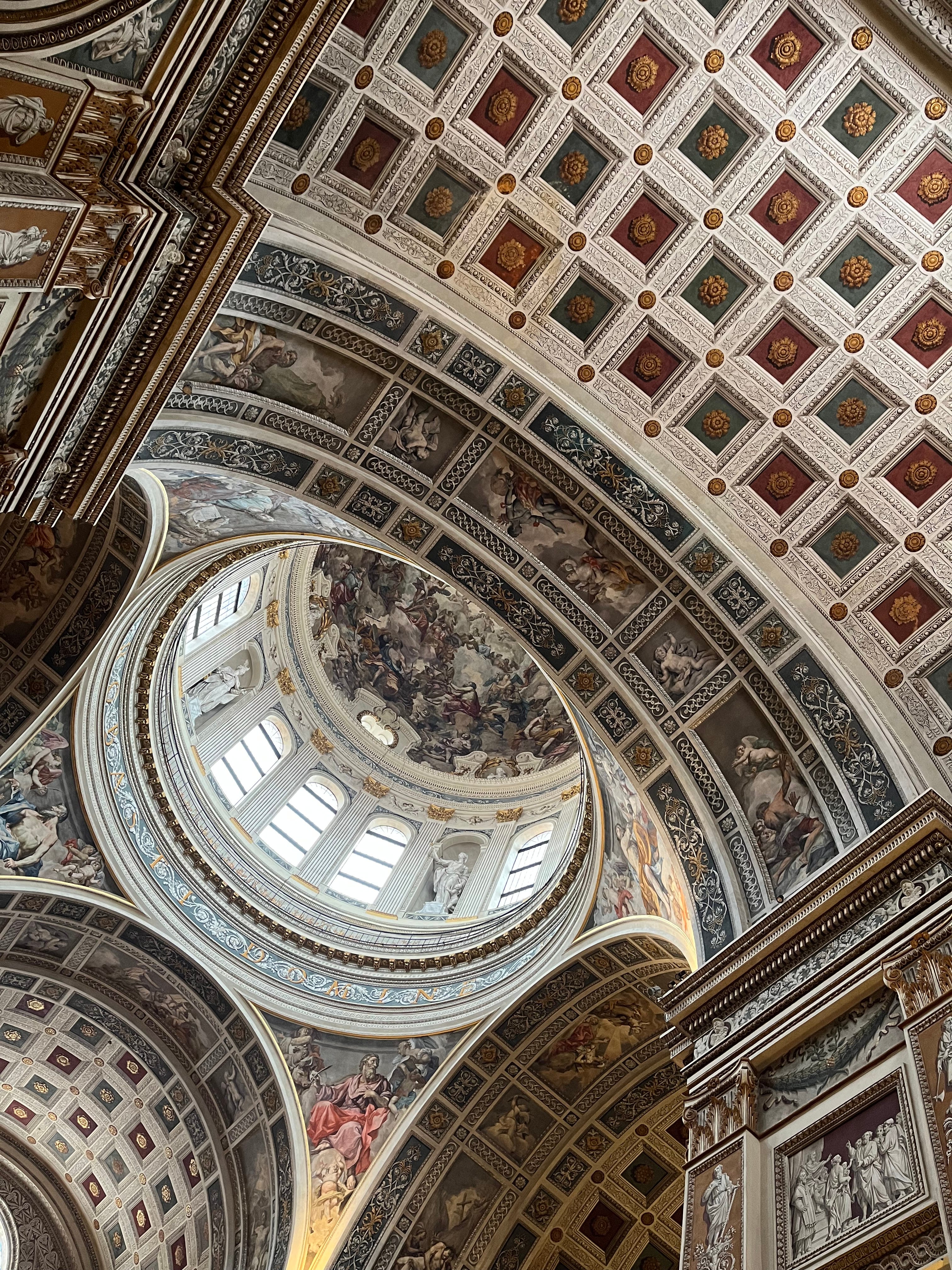
I walked into the small piazza where the basilica lives and stared at a facade that I knew from photographs. Over the years I had pictured myself walking into this structure many times and I was finally here, in the physical, in the present. I looked at the barrel vault in the portico. I looked at the floor. I looked at the capitals of the pilasters, the grotesques flanking the door lintel. I looked up at the familiar face towering above me fast becoming a stranger to me in real time. Time present blending time past with time future. Imagined time. An imagined vision of the future created in the past, correcting itself in the present. And time future becoming time present becoming time past. At one time, I had imagined us visiting this work while we were still together. Me giving an unsolicited guided tour of the architectonic features, him indulging me momentarily before escaping, him returning to tell me how garish he found church decor, how these enormous silent spaces made him want to run up the nave screaming. Me rolling my eyes with a small smile, but then adding in a low voice with upmost sincerity and seriousness: “We simply do not have the same visual literacy today as our ancestors did. Peccato.” Me silently chastising myself for my sincerely held beliefs. None of this happened.
In another time, many years ago, I had also pictured being there with my ex-boyfriend during a year travelling around Italy. There’s a pattern here. Mantova is somewhat awkward to get to, we never made it. I stood under the portico and told my companion to go ahead and I would follow. I wanted to be alone. I needed the ghosts to fade. After all these years I could not cross this threshold with stains in my mind. I thought of my professor of architectural history, my first and only mentor and one of the most inspiring people I have ever met. It was she who introduced me to Alberti and Sant’Andrea. I imagined her standing there with me, a woman of tiny stature, a walking brain, always in platformed shoes, hair in a french roll with a chic little fringe, shrouded in a black woollen cape, her eyes and voice exploding with enthusiasm and passion. I would have liked for her to be there with me, walking slowly side by side down the nave, arm in arm, her telling me the secrets of the building in an attempted whisper. I walked through the door alone.
I knew exactly what I was going to see. I was fairly certain what I would feel. The scale is enormous, humbling and silencing. The eyes cannot take in the entire elevation at once. It is sublime, in the Hegelian sense, a vision or experience that evokes a sensation of incomprehension, fear and awe. These monuments contain so much: power, wealth, oppression, suppression, concepts of beauty, devotion, ideas of grandeur, spaces for human ritual, meditation, control, solace, suffering. I thought of the men who built it: what did they eat, what did they sing or chat shite about while laying bricks or slathering stucco? I thought of the millions of people who have walked through that space over five-hundred years, the clothes they all wore, the tears that have been shed in fear, celebration, shame or mourning. How would this space feel after dusk in the candlelit time before electricity? I would like to walk through that space by candlelight.
I exited the basilica thinking of a time in Bordeaux cathedral when I had walked through the building in the dark solely illuminated by candles. It was magical. It is how most of humanity has experienced the interior of churches over time before the late 19th Century. And Bordeaux cathedral, adhering to Gothic principles, is extraordinarily tall. Looking towards the ceiling in the darkness was like looking down to the sea floor in open water. Blackness.
I have seen Alberti’s other notable works in Firenze many times: the facade of Palazzo Ruccellai and the upper facade of Santa Maria Novella. Many years ago, while en route to a farm near Urbino, my train was delayed for twenty minutes in the coastal city of Rimini. There was a storm. According to Google maps, Alberti’s Tempio Malatestiano was maybe a five-minute run from the platform, in a more or less straight line. The Tempio is Alberti’s first ecclesiastical work, and the first time the triumphal arch motif appears in a church facade. I ran through the wet and windy dark. And after a slight bend in the street, there it was, the unfinished temple front illuminated in artificial light, shining stone in the rain. It was beautiful. Alberti was as good in practice as he was on paper. I smiled at the temple, my face and clothes soaked from the downpour, and turned back to the soon-departing train.